Temporary exhibitions


The Interpretation Centre permanent exhibition is complemented by Temporary Exhibitions inside its facilities, whose objective is to make local master craftsmen known. They keep the traditional pottery of the area alive with their hands and/or they design new methods for a more environmentally-friendly artistic creation.


<br>

lunes, 13 de abril de 2015

Walking through Guadix hills between chimneys II


Once again, on 8th April, we commemorate the International Roma Day, as established by the United Nations. It reminds the first meeting of Roma representatives, which took place in London on 8th April 1971 at which the flag and the Roma hymn, “Gelem Gelem”, were established. It is a date of celebration, to make the unit and diversity of Roma people from all over the world more visible and the important Roma contributions to the universal culture.

Pictures:


DIGITAL ART, Ventura Hernández


I would like to thank those people who let me be myself, the City Council of Guadix and the different Guadix media for the support they offer to me and their response to my exhibitions.

Buenaventura Robles Hernández was born in Alcudia (Valle del Zalabí) in 1984. From a humble family, he studied in his town and Guadix and he ­finished his academic training at the Guadix School of Arts. His passion for art began from an early age, when he painted in pencil and charcoal. Later, he started to experiment with other techniques such as acrylic, oil or digital art, which is the technique of this exhibition. Currently, he works as a waiter at the Palacio de Oñate Hotel. So far, he made an exhibition at the Guadix Tourist Office.

Pictures:


Recycling: A child’s play


ATANI is non-profit organization which arose in 2001 from the anxiety felt by a group of mothers who, being affected by their sons and daughters’ drug addiction, look for aid for their treatment and subsequent reintegration.

At the present time, one of the projects developed by this organization since 2001 is the PIMA (Program for the Comprehensive Prevention in an Open Environment) through which they work with groups of minors the values education and attitudes that act as protection factors facing the offer and the use of drugs. They are: tolerance to the frustration, self-esteem, commitment and respect for the nature. It hopes to be an alternative to the leisure consumer model that prevails nowadays.


The program currently focuses on a recycling workshop that allows us to work with children through a range of leisure which parts of their interests and where they go on their own initiative, values ​​and attitudes that will enable them to confront the risks to be turned up along their young adult life.

In this exhibition, recycled toys which were made during the 2013-14 course are presented. Through them, children discovered that making their own toys implies a double fun.

Pictures:


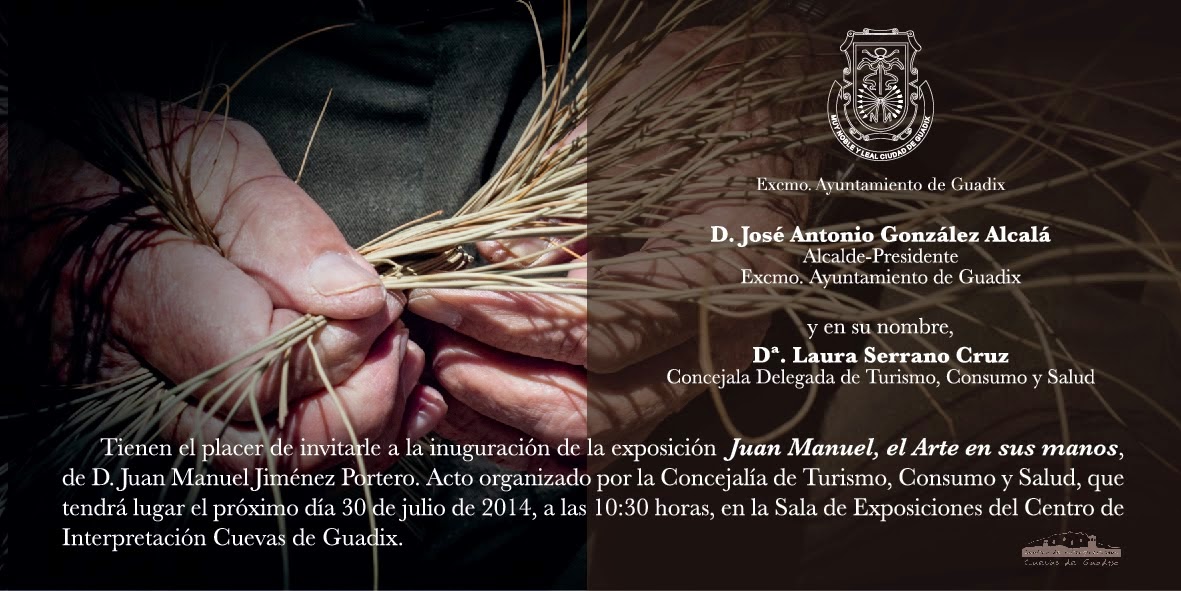
“Art in Juan Manuel’s hands”


Since prehistoric times, men have used the ‘esparto’ grass to make all sorts of objects intended for different uses. At the very beginning of History, writers such as Homer, Pliny, Strabo... made reference in their writings to its use in the making of riggings for Greek ships, to its applications in textiles and to its exports from Carthage to the rest of the Mediterranean sea. In the Middle Ages, it represented one of the key elements in a natural economy of livelihood. Multiple entries about how esparto grass is worked and its dissemination were collected in 16th century Song Books. Moreover, 18th century Travel Books have constant references to this fibre and handmade items, which were made all over the Spanish territory.

Nowadays, an emerging oblivion and the consequent gradual loss of this primitive work point to its worst future if we do not value and transmit the wisdom and works of esparto lovers, among which Juan Manuel Jiménez Portero is found in a prominent place.

The obtaining and transformation of the raw material is not an easy process. It begins with the summer harvest in the ‘atochares’ (esparto field), transport, drying, fermentation, the paste, raking and spinning. After this job, the making of ropes, plaits, pleitas, baskets, espadrilles, sacks, blowers, fly swatter, saddle bags, cenachos, packsaddle or any decorative object takes place.

Juan Manuel Jiménez  Portero learned the secrets of this art from a very early age by merely looking. Parallel with his different professions, he kept his love for the esparto throughout his life. He participated in several craft markets in his town, Huéneja, with magnificent works which showed the traditional identity of esparto and reflected what his skilful hands created, his tireless hope.

Today, his family wants to pay tribute to him through the presentation of his works exhibition in Guadix, by extending the recognition and the gratitude for all he made with difficulty and dedication in his professional and personal life. 
Thank you, Juan Manuel!

Pictures: